



























 ·
7 minute read
·
7 minute read

2025 was an eventful year for the job market in Belgium. Between economic uncertainty, the accelerated adoption of new technologies and unprecedented expectations from candidates, recruitment underwent a real strategic shift.
In 2026, these trends will intensify. To attract the best talent and secure your recruitment, it is essential to understand these developments and know how to put them into practice.
| At Profile Group and Jobat, we support our clients on a daily basis and closely monitor these changes. Here is our analysis of the situation on the ground and our practical advice for the new year. |
More application 📥
Data-driven recruitment 📊
AI and automation supporting recruiters👩💻
Generation Z in the job market 💭
Pay transparency 💸
Potential-based recruitment 🧠
More applications 📥
The Belgian job market remains active, but is becoming more complex. The number of job vacancies is falling, while the number of job seekers is rising.
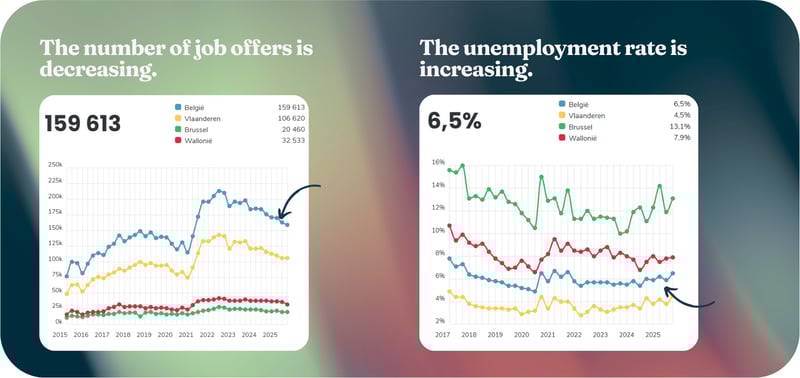
Source: Statbel (Q3, 2025)
| 51% of Belgian professionals are considering changing jobs in 2026. Source: Robert Walters (2026) |
Motivations go far beyond salary: personal development, continuing education, and dissatisfaction with their current position are all factors that drive candidates to move on.
Jobat also recorded a 119% increase in the number of monthly applications in 2025, a significant increase.
The Net Employment Outlook for the first quarter of 2026 is +14%, the lowest since 2021 and 10 points below the global average. The market therefore remains dynamic but more cautious than a few years ago.
Source: Manpower Group (2025)
However, certain sectors remain challenging for employers seeking new profiles: the non-profit sector, science and services, commerce, industry and construction.
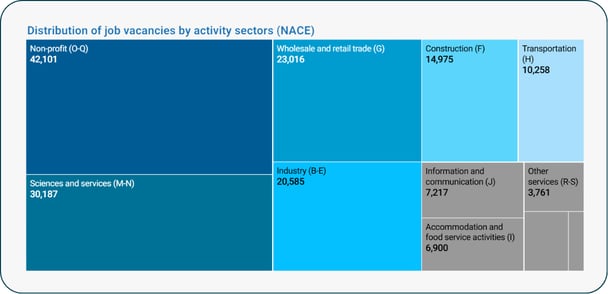
Source: Statbel (Q3, 2025)
There are more candidates, but not all of them meet the specific needs of companies..
Our recommendations
- More applications ≠ less work: A higher volume requires, above all, a clear, simple and well-structured recruitment process, supported by an effective ATS.
- Your internal talent may be on the move: Your ability to retain them will be key: remuneration, flexibility, working environment, team quality and stability.
- No return to an employer-driven market: Certain roles remain difficult to recruit for. Your Employee Value Proposition must therefore be clear, consistent and aligned with your target audience.
- Your search must be targeted: The vaguer the job offer, the more applications will be off-target. Define a precise profile, with clear responsibilities and a well-defined place in the organisation.
Data-driven recruitment 📊
Data-driven recruitment has now become a strategic lever.
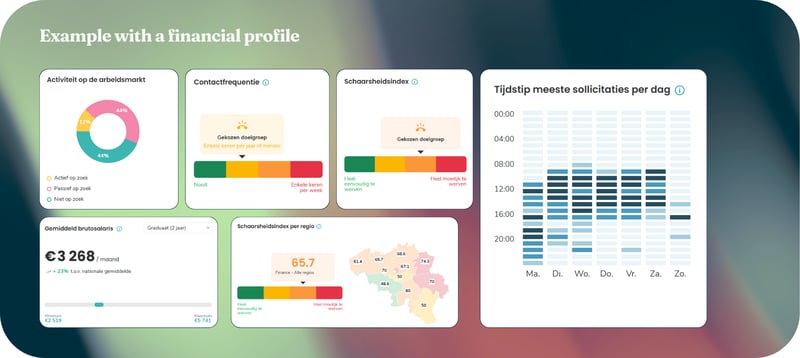
With platforms such as Jobat Insights, you can analyse a profile even before publishing a vacancy: scarcity index, market activity, average salary by level of experience, and the channels used by candidates.
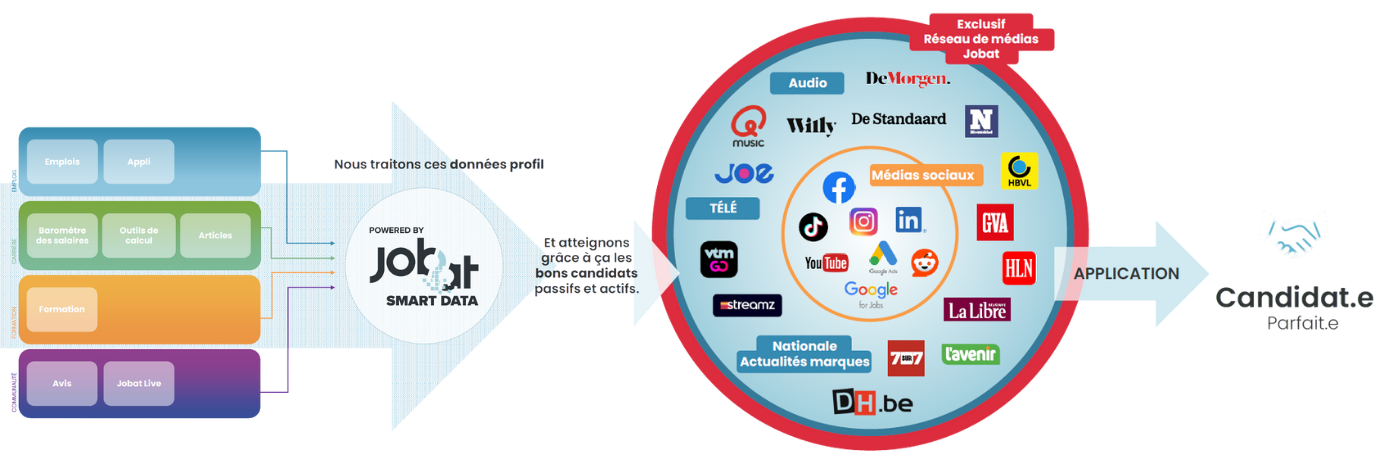
At the same time, Jobat uses candidate data to contact them via the most suitable channels. In 2025, they were able to improve their click-through rate by 25% thanks to data-driven targeting.
Once your recruitment is on the right track, it is time to analyse the data linked to your recruitment process (your recruitment KPIs).
- The click-through rate measures how attractive your job advert is. (= Number of clicks on the advert ÷ Number of impressions × 100)
- The application rate measures your job advert’s ability to convert candidate interest into actual applications. (= Number of applications ÷ Number of clicks × 100)
- Candidate sources indicate which channels are most effective for generating applications.
- The percentage of candidates by gender helps you analyse the diversity of the profiles attracted by your advert and identify any potential bias in the distribution or content of the advert. (= Number of candidates by gender ÷ Total number of candidates × 100)
- Time-to-hire measures the speed of your recruitment process. (= Date the offer is accepted – Date the role is opened)
- Cost per hire generally includes job boards, agency fees, the ATS and the time spent by recruiters/managers. (= (Internal costs + external costs) ÷ Number of hires)
- The offer acceptance rate indicates how well the offer matches candidates’ expectations. (= Number of offers accepted ÷ Number of offers sent × 100)
- The candidate Net Promoter Score measures the candidate experience. (“Would you recommend our recruitment process?” (0–10))
Our recommendations
-
Responsiveness and proactivity: Base your decisions on facts. Set your strategy off on the right foot and adjust it where needed by measuring before, during and after.
-
Improved ROI on your recruitment activities: Track your key indicators, rebalance your efforts towards the most effective channels and make sure every euro invested in recruitment delivers maximum value.
-
Use reliable tools: To leverage your internal data, an ATS is essential. To better understand the market and its trends, rely on solutions such as Jobat Insights or Talent Insights.
-
Choose your battles: Not all KPIs are equal – focus on those with the greatest impact in the context of your specific recruitment.
AI and automation supporting recruiters 👩💻
This is not a new trend, but it will clearly accelerate this year. Artificial intelligence supports recruiters across a range of tasks:
-
Writing job adverts (ChatGPT, Copilot, Leexi)
-
Identifying and tracking talent (LinkedIn Recruiter)
-
Scheduling interviews (Calendly, automated tools)
-
Predictive matching (AssessFirst)
At every stage, humans remain essential. Technology is there to enable and support them.
At Jobat, AI helps to distribute adverts to the right people based on role, region and user behaviour, significantly improving the quality of applications.
Our recommendations
-
Use AI as a complementary tool: AI enhances your decisions but never replaces human dialogue – motivation, cultural fit and soft skills remain essential.
-
Automate repetitive tasks: Follow-ups, candidate tracking, note-taking and analysis can be handled by AI, freeing up time for higher-value activities.
-
Adapt your sourcing using data: Leverage AI-generated insights to fine-tune your campaigns and identify talent where they are, always with human oversight.
-
Regularly check relevance and fairness: Make sure AI filters and recommendations remain fair, consistent and aligned with your recruitment objectives.
Generation Z in the job market 💭
People talk a lot about Generation Z, but often in an over-simplified way, with clichés that do not always reflect reality. To really understand this generation in the labour market, you first need to look at the socio-economic context in which it has grown up.
Generation Z, born between 1997 and 2012, is entering the world of work in a deeply unstable environment. Persistent inflation, a high cost of living, increasingly difficult access to housing and less linear careers than those of previous generations all directly shape their relationship with work.
| By 2030, they will account for around one third of the workforce, making them a major strategic priority for recruitment in 2026. |
Contrary to some popular beliefs, their expectations are not disconnected from economic reality. On the contrary, they are highly rational:
-
financial stability,
-
opportunities for development,
-
long-term employability.
Salary is still important, but it is no longer the only criterion.
Gen Z has grown up watching older generations go through burnout, restructurings, redundancies and professional insecurity. As a result, many reject the idea of personal sacrifice in favour of a traditional, linear career. In a context of ongoing climate crisis and constant exposure to information (social media, real-time news), work is seen as a lever, not an end in itself.
In practical terms:
-
Work–life balance is non-negotiable.
-
Flexibility is a basic expectation, not a “nice-to-have” perk.
-
Mental health is an integral part of the employment relationship.
-
Loyalty is not automatic – it is built over time.
For this generation, success is not limited to climbing the corporate ladder. It is measured more by the alignment between work, personal values and quality of life.
Having grown up with screens, Gen Z is fully fluent in digital tools and social media. They therefore expect organisations to be modern, consistent and transparent.
Above all, they are reshaping management expectations:
-
Clear limits on workload
-
A rejection of micromanagement
-
A need for trust and mutual respect
-
A manager’s credibility based on human qualities rather than status
Beware of clichés: saying that “Gen Z is lazy” is a misreading. This generation has mainly been taught to protect itself, safeguard its balance and seek sustainable fulfilment. It is not a lack of commitment, but a different definition of commitment.
Our recommendations
-
Raise awareness of generational differences: The strength of your teams also lies in this diversity. Help people understand each other better and work together effectively.
-
Provide visibility on career prospects: Remember that for Generation Z, opportunities are not just about climbing the hierarchy – development, varied projects and learning matter just as much.
-
Create safe spaces: Make your organisation a place where employees feel comfortable talking about their wellbeing. Build these conversations into performance reviews and regular team meetings.
-
Avoid one-size-fits-all thinking: Generational trends are indicators, not rules. Treat every employee as an individual with their own aspirations.
Pay transparency 💸
For a long time, wage transparency remained a sensitive issue in Belgium. Taboo for some, uncomfortable for others, it was often perceived as a risk rather than an opportunity. In 2026, this debate is no longer theoretical.
From June 2026, the European directive on wage transparency will require employers, among other things, to:
-
to indicate the salary or salary range in job offers,
-
to no longer ask candidates about their salary history.
The objective is clear: to reduce pay gaps, particularly between women and men, and to create greater fairness and transparency in the labour market.
Beyond the legal aspect, pay transparency marks a profound change in the employer-candidate relationship. Candidates want to quickly understand whether an opportunity meets their expectations. Salary is not the only criterion, but it remains the starting point for any discussion.
The figures from Jobat speak for themselves:
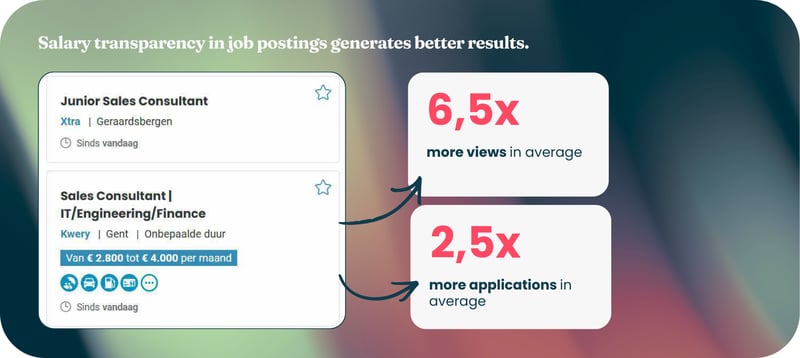
These figures show a simple reality: displaying the salary does not scare candidates away, quite the contrary. It attracts more qualified, better-suited candidates and avoids lengthy processes with candidates who are outside the budget.
And in any case, salary remains the number one expectation of talented individuals when it comes to a job.
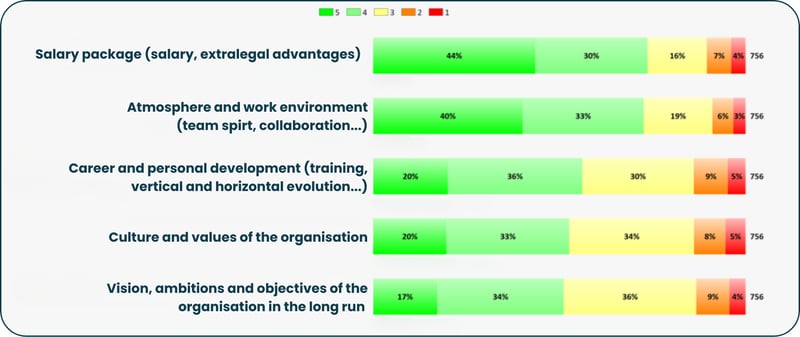
Source : Listen (2025)
Our recommendations
- Start displaying salaries in your job offers: Target candidates who fit your budget, reduce lengthy negotiations, and demonstrate your transparency before the law comes into effect.
- Review and justify your salary scales: Analyse the consistency of salaries by position today and ensure that your compensation criteria are transparent and fair.
- Compare your salaries to those on the market: Numerous salary guides are available to give you an idea of market practices and help you remain attractive.
Potential-based recruitment 🧠
Potential-based recruitment is about identifying and attracting candidates based on their ability to learn, grow and adapt, rather than solely on their current skills and experience.
| Employees recruited for their potential are 1.9 times more likely to perform effectively than those hired solely for their current skills. Source : Gartner (2025) |
A skills-based approach strengthens your organisation’s flexibility. It enables you to mobilise talent across a variety of projects, based on real needs. Rather than thinking in silos or fixed roles, you identify the skills available internally and bring them together around projects.
The key soft skills sought include, for example:
-
Ability to learn
-
Problem-solving
-
Critical thinking
-
Curiosity
-
Adaptability
-
Emerging leadership
-
Communication
-
Creativity
-
Autonomy
Our recommendations
-
Look inside your existing talent: The rare gem may already be in your organisation. Encourage bold moves to help your employees develop quickly.
-
Support your managers: They are crucial relays, able to spot potential and nurture it on a daily basis.
-
Create development pathways: Training, mentoring and dedicated initiatives give your people the means to turn their potential into results.
-
Integrate objective assessment tools: Use reliable tools and an external perspective to identify high-potential talent.
Conclusion
Recruitment in 2026 will require you to combine technology, data, flexibility and humanity – concepts that are often seen as being at odds with one another. Your challenge will be to make them work together in a harmonious way.
At Profile Group, we support our clients in turning these trends into concrete actions, with a tailored approach that combines expertise, innovative tools and strategic vision.


.png)
